BOS (Break of Structure)
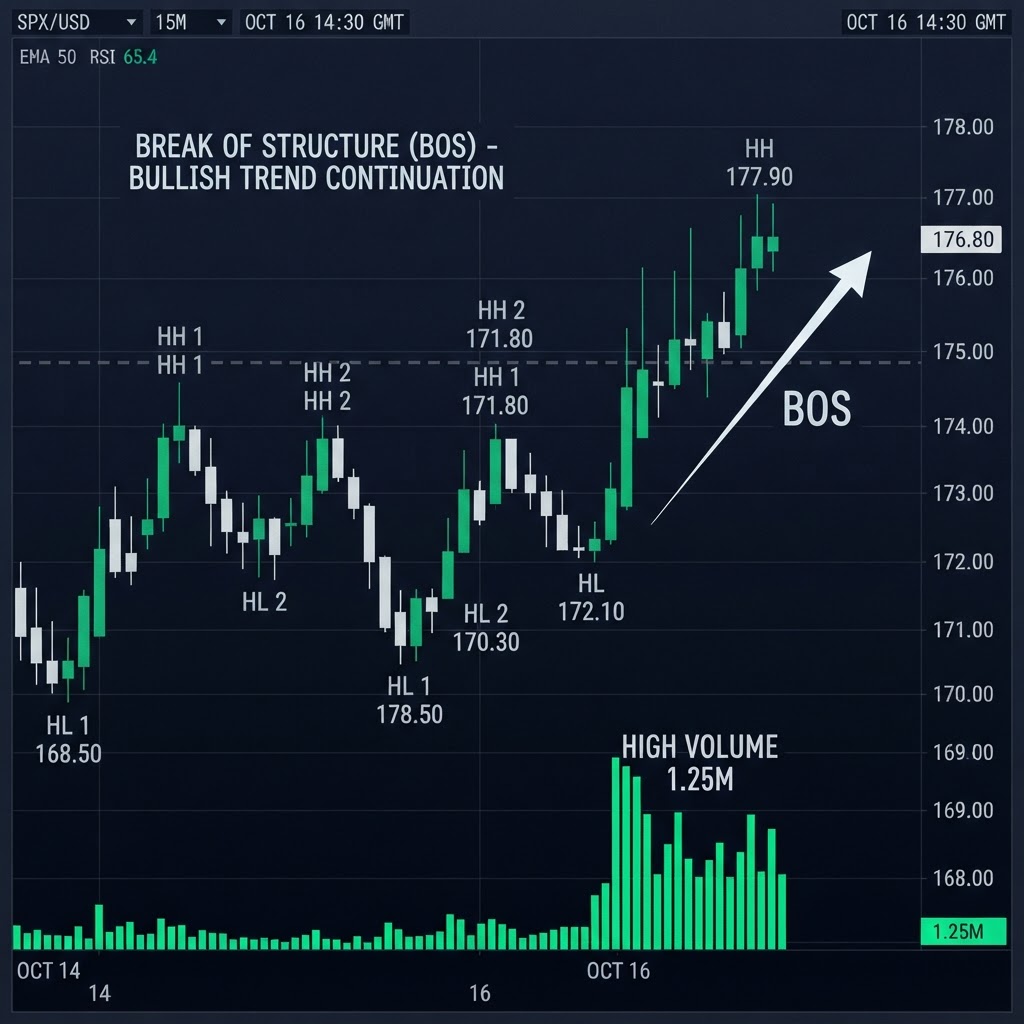
Institutional Thesis
The Break of Structure (BOS) is the ICT terminology for what Dow Theory calls trend confirmation — the moment price exceeds a prior swing extreme in the direction of the prevailing trend, confirming that the balance of order flow remains directional. Academic trend-following literature (Moskowitz, Ooi & Pedersen 2012, 'Time Series Momentum') demonstrates that assets that have broken prior highs (positive momentum) continue to outperform on a forward basis. The BOS is the micro-structural signature of this momentum: it tells the operator that the institutional flow driving the trend is still active and has not been exhausted or reversed.
Technical Definition
A Break of Structure is the close of price beyond a prior swing high (in an uptrend) or a prior swing low (in a downtrend), confirming trend continuation. It is distinguished from a ChoCH (Change of Character) by direction: a BOS breaks in the trend direction; a ChoCH breaks against it. Validity requires a displacement-grade candle (not a marginal poke) and ideally a volume confirmation on the breakout candle.
Order-Flow Microstructure
A BOS occurs when institutional buy-side flow (in an uptrend) overwhelms the sell-side interest that created the prior swing high. The prior high represented a price where sellers previously overwhelmed buyers; breaking it means buyers now dominate at a level where they previously could not. The prior high, once broken, becomes a structural support — it is the level where the institutional flow that created the BOS is 'anchored.' When price retraces to this level, it often bounces because residual institutional interest and breakout-buyer stop-rolls create demand. This is why BOS levels are tradable on retest, not just on breakout.
Identification Framework
1) Identify the prevailing trend (sequence of HH+HL for uptrend, LH+LL for downtrend). 2) Locate the most recent unbroken swing high (uptrend) or swing low (downtrend). 3) Wait for price to close beyond that level — a wick-through is insufficient; a body close is confirmation. 4) Assess the displacement: a BOS candle with range >= 1.5x ATR and a close near its extreme is a high-quality break; a marginal close with a long opposite wick is a low-quality break. 5) Mark the BOS level — this is the new structural reference. The strongest BOS is one that breaks a level that has held multiple times (a liquidity-rich level), because the break consumes significant opposing flow.
Confluence Architecture
A BOS is a directional confirmation, not an entry by itself. The operator uses it in two ways: (1) On retest — after the BOS, price retraces to the broken level; if it holds (bounces), enter in the trend direction with stop beyond the BOS candle's opposite extreme. (2) As a trend filter — only seek OTE, OB, and FVG entries in the direction of the higher-timeframe BOS. A BOS combined with a displacement (and the FVG it generates) is a 'confirmation stack' — the trend is confirmed and the order-flow imbalance is visible. A BOS during a Killzone adds institutional timing. Multiple-timeframe BOS alignment (e.g., 4H and 1H both breaking structure in the same direction) is the highest-probability continuation environment.
Institutional Execution Model
There are two valid BOS executions. (1) Retest entry: after the BOS, wait for price to return to the broken level. Seek a lower-timeframe confirmation (OB, FVG, or ChoCH in the trend direction). Enter with stop just beyond the BOS candle's origin, targeting the next liquidity pool or the measured move. (2) Momentum entry: on a displacement-grade BOS with volume, enter on the first pullback to the FVG generated by the BOS candle. This is more aggressive but offers better R/R. In both cases, the BOS defines the directional bias — never trade against a just-confirmed higher-timeframe BOS.
Risk Management Framework
BOS-retest trades have moderate probability (~60-70%) but excellent R/R because the stop is tight (just beyond the BOS level) and the target is the next liquidity pool at distance. Risk 0.75-1%. If price returns beyond the BOS level and closes there, the break has failed — it was a false BOS, and the structure may be setting up a ChoCH. Exit immediately; do not hold a failed BOS trade hoping for a second break. The institutional operator treats a failed BOS as information (the trend may be exhausting), not as a loss to revenge.
The institutional operator deploys BOS (Break of Structure) only when the full confluence stack is present — structure, order-flow imbalance, value alignment, and Killzone timing. The edge is not the pattern itself; it is the convergence of independent confirmations that collectively reduce the false-positive rate to acceptable levels. Trade the process, not the outcome.
BOS (Break of Structure) — Test your knowledge
Sign in to take the quiz
Quizzes are reserved for registered users. Create a free account to test your knowledge, track your progress and save your results to your personal profile.
Weekly market setups, new guides and AI insights. Free, zero spam.