Displacement
Institutional Thesis
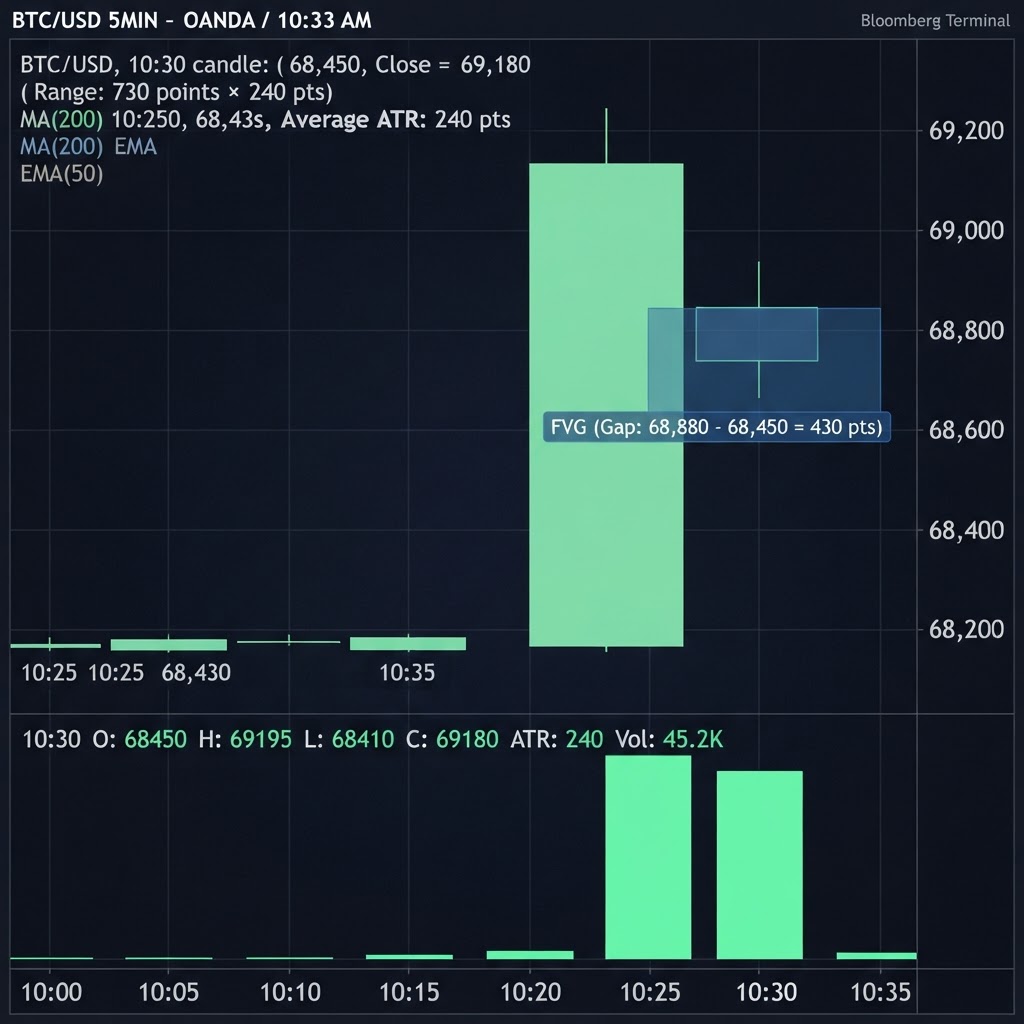
Displacement is the ICT term for what market microstructure literature calls informed order flow — a sudden, aggressive, directional move that reflects the entry of a large, informationally-motivated participant. The academic literature on price impact (Kyle 1985, 'Continuous Auctions and Insider Trading') establishes that informed flow produces distinguishable price signatures: wider ranges, stronger closes, and higher volume relative to the prior norm. Displacement is the visible signature of institutional intent. It is the engine that creates FVGs, breaks structure (BOS), and originates OBs — without displacement, there is no institutional conviction, and the subsequent structural levels are noise.
Technical Definition
Displacement is an impulsive, aggressive price move characterized by one or more candles with range significantly exceeding the prior average (>= 2x the 20-period ATR), a close near the candle's extreme (>= 70% of the range), and typically elevated volume. A displacement candle almost always generates a Fair Value Gap in its structure and frequently coincides with a Break of Structure. It is the institutional footprint — the moment a large participant commits capital with conviction.
Order-Flow Microstructure
Displacement occurs when an institution executes a large order aggressively (via market orders or aggressive limit orders) rather than passively. The aggressive execution consumes all resting liquidity within a price band faster than the order book repopulates, producing: (1) a wide candle (the range reflects the distance over which liquidity was consumed), (2) a close near the extreme (the institution's order flow is one-directional, so price closes where the flow ended), and (3) an FVG (the rapid traversal leaves a price band with no two-sided trade). The volume spike reflects the size of the executed order relative to normal flow. Displacement is therefore the direct, observable evidence of institutional commitment — and the levels it creates (the origin OB, the FVG, the BOS) are backed by real order flow, not by pattern self-fulfillment.
Identification Framework
1) Measure the 20-period ATR on the operating timeframe. 2) Identify candles (or tight clusters) with range >= 2x ATR and close in the upper 30% (bullish) or lower 30% (bearish) of the range. 3) Confirm the displacement generated an FVG (the three-candle imbalance). 4) Check for a BOS: did the displacement break a prior swing high or low? 5) Mark the origin of the displacement (the last counter-trend candle before the move) — this is the OB. The highest-quality displacements occur during Killzones (London/NY opens) and are accompanied by volume spikes. A displacement in the dead zone (illiquid hours) with no volume is suspect — it may be a thin-market spike, not institutional flow.
Confluence Architecture
Displacement is the foundational event; confluence is built on top of it. A displacement that breaks structure (BOS) and generates an FVG from an OB is the 'institutional trifecta' — the three core ICT concepts in a single move. The operator then waits for price to retrace to the FVG or the OB (which often coincide) and seeks entry in the displacement direction. Displacement + Killzone timing confirms institutional origin. Displacement + a higher-timeframe trend alignment (the displacement is in the direction of the higher-timeframe BOS) is a continuation signal. Displacement against the higher-timeframe trend may be a ChoCH — the first sign of reversal — and should be treated with the ChoCH framework (wait for confirmation).
Institutional Execution Model
1) Identify a displacement candle/cluster and mark the FVG and OB it generated. 2) Determine the directional bias: a displacement in the trend direction (after a BOS) is a continuation; a displacement against the trend may be a ChoCH. 3) Wait for price to retrace to the FVG or OB — do not chase the displacement. 4) At the FVG/OB, seek a lower-timeframe confirmation: a 1m or 5m ChoCH in the displacement direction. 5) Entry on the confirmation, stop beyond the FVG/OB extreme (beyond the displacement origin), target the next opposing liquidity pool or the measured-move extension (1.272 or 1.618 of the displacement). R/R is favorable because the stop is tight (just beyond the origin) and the target is the full extension.
Risk Management Framework
Displacement-based entries (entering on the retest of the FVG/OB created by the displacement) are the core ICT trade. Risk 0.75-1.25% per trade. The displacement itself is the evidence of institutional commitment; the retest entry is the low-risk way to align with it. If price closes beyond the displacement origin (beyond the OB/FVG), the institutional move has been fully consumed or reversed — exit immediately. The operator does not enter a second time on the same displacement after invalidation; a new displacement (in either direction) is required to generate a new setup. Scale out at the first liquidity target and trail the remainder using lower-timeframe structure breaks in the displacement direction.
The institutional operator deploys Displacement only when the full confluence stack is present — structure, order-flow imbalance, value alignment, and Killzone timing. The edge is not the pattern itself; it is the convergence of independent confirmations that collectively reduce the false-positive rate to acceptable levels. Trade the process, not the outcome.
Displacement — Test your knowledge
Sign in to take the quiz
Quizzes are reserved for registered users. Create a free account to test your knowledge, track your progress and save your results to your personal profile.
Weekly market setups, new guides and AI insights. Free, zero spam.