Premium & Discount
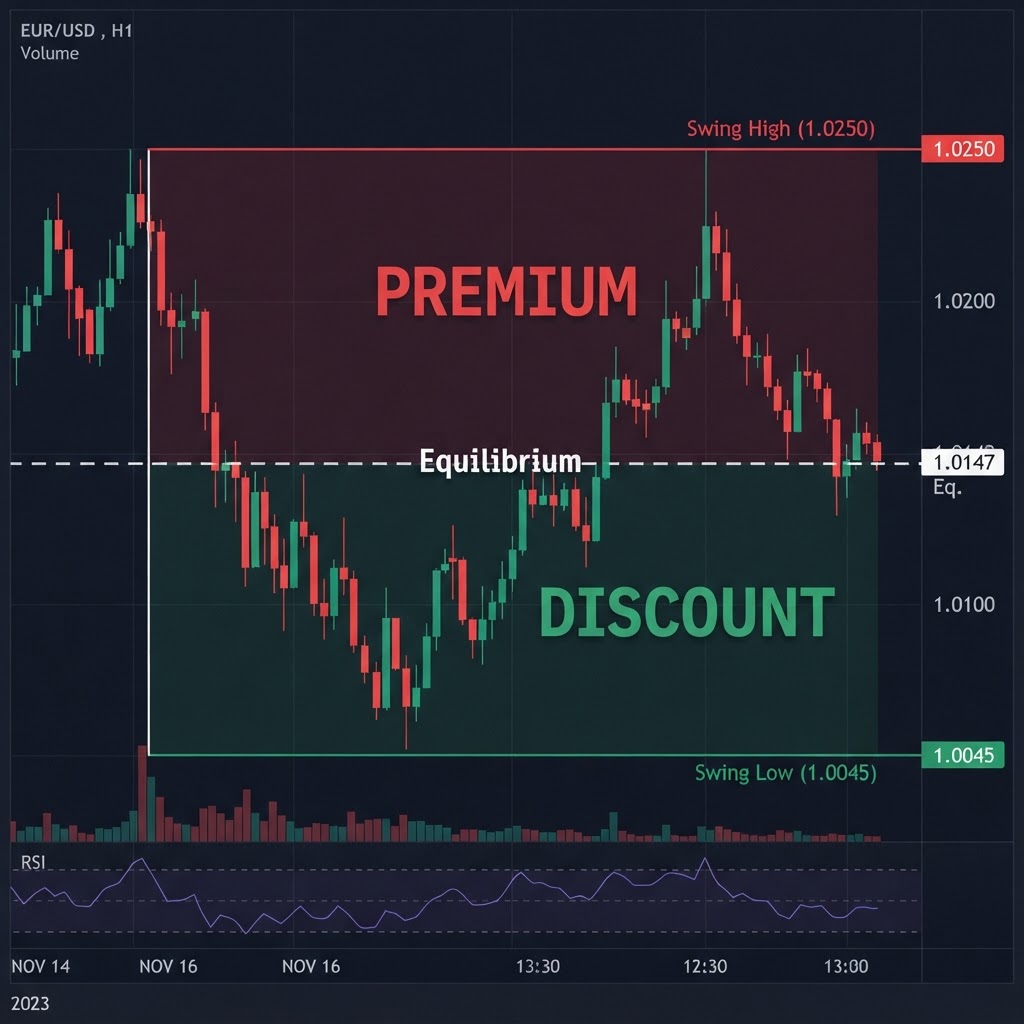
Institutional Thesis
The Premium/Discount framework is the ICT binary decision filter derived from the efficient-price principle: within any defined range, the 50% level (Equilibrium) divides 'expensive' from 'cheap' relative to that range. Academic literature on mean-reversion (De Bondt & Thaler 1985) and range-based volatility (Garman & Klass 1988) supports the premise that price within a range is not uniformly priced — the upper half carries statistical sell-side bias, the lower half carries buy-side bias. The operator uses this framework as the first question before every entry: 'Am I buying at a discount or selling at a premium?' This prevents the systemic retail error of buying tops and selling bottoms.
Technical Definition
Premium and Discount divide a price range (defined by a swing high and a swing low) at the 50% level (Equilibrium). The upper half — from 50% to the swing high — is the Premium zone: price is relatively expensive, the preferred zone for seeking short entries. The lower half — from 50% to the swing low — is the Discount zone: price is relatively cheap, the preferred zone for seeking long entries. The 50% level itself is Equilibrium, the point of statistical balance.
Order-Flow Microstructure
Within a trading range, institutional flow operates on a value framework: buy low (Discount), sell high (Premium), and harvest the reversion to Equilibrium. This is not mere mean-reversion theory — it is observable in the order flow of range-bound instruments: buy-side institutional flow concentrates in the lower half of the range (accumulation), sell-side flow concentrates in the upper half (distribution). A retail trader buying in the Premium zone is buying at the level where institutions are distributing — the worst possible execution. The Premium/Discount filter forces alignment with institutional value logic: longs are sought where institutions accumulate (Discount), shorts where they distribute (Premium). The 50% level acts as a gravitational center: price tends to revisit it because it is the equilibrium between the two flows.
Identification Framework
1) Identify the operating range: the most recent significant swing high and swing low that define the current price consolidation or trend leg. 2) Draw the 50% level between them — this is Equilibrium. 3) The upper half (50% to high) is Premium; the lower half (50% to low) is Discount. 4) Determine directional bias from the higher-timeframe structure (is the trend bullish or bearish?). 5) If bullish, seek long entries only in the Discount zone; if bearish, seek short entries only in the Premium zone. The operator does not enter a long at the Premium level even if a bullish signal appears there — the Premium/Discount filter overrides the signal because the R/R of buying at a premium is structurally adverse.
Confluence Architecture
Premium/Discount is the macro filter; structure provides the micro entry. A long entry in the Discount zone that coincides with an OB, an FVG, or an OTE completion is the institutional confluence stack: value alignment (Discount) + order-flow zone (OB/FVG) + Fibonacci precision (OTE). A short in the Premium zone with the same confluence is the mirror setup. The full stack (Premium/Discount + OB + FVG + OTE + Killzone) is the highest-probability ICT configuration. The operator may also use Premium/Discount as an exit filter: if long from Discount and price reaches the Premium zone, scale out — the value edge has been captured.
Institutional Execution Model
1) Map the range and draw Premium/Discount. 2) Determine directional bias from higher-timeframe BOS/structure. 3) Wait for price to enter the correct zone (Discount for longs, Premium for shorts). 4) Within the zone, seek a structural entry: an OB, FVG, or OTE completion with a lower-timeframe ChoCH confirmation. 5) Entry on the confirmation, stop beyond the zone extreme (the swing low for Discount longs, the swing high for Premium shorts), target the opposite zone boundary (the swing high for Discount longs, the swing low for Premium shorts) or beyond to the next liquidity pool. R/R is inherently favorable because the entry is at the cheap/expensive end of the range and the target is at the opposite end.
Risk Management Framework
Premium/Discount trades are value trades — the R/R is favorable because the stop is at the range extreme (tight relative to the range) and the target is the opposite extreme (the full range). Risk 0.75-1.25% per trade. If price closes beyond the range extreme (beyond the swing high or low that defined the range), the range has broken and the Premium/Discount framework is invalidated for that range — re-map to the new range. The operator does not hold a Premium/Discount trade through a range break; the value thesis is binary — either the range holds (and the trade works) or it breaks (and the thesis is dead). Scale out at Equilibrium and at the opposite zone boundary.
The institutional operator deploys Premium & Discount only when the full confluence stack is present — structure, order-flow imbalance, value alignment, and Killzone timing. The edge is not the pattern itself; it is the convergence of independent confirmations that collectively reduce the false-positive rate to acceptable levels. Trade the process, not the outcome.
Premium & Discount — Test your knowledge
Sign in to take the quiz
Quizzes are reserved for registered users. Create a free account to test your knowledge, track your progress and save your results to your personal profile.
Weekly market setups, new guides and AI insights. Free, zero spam.