Power of Three (AMD)
Institutional Thesis
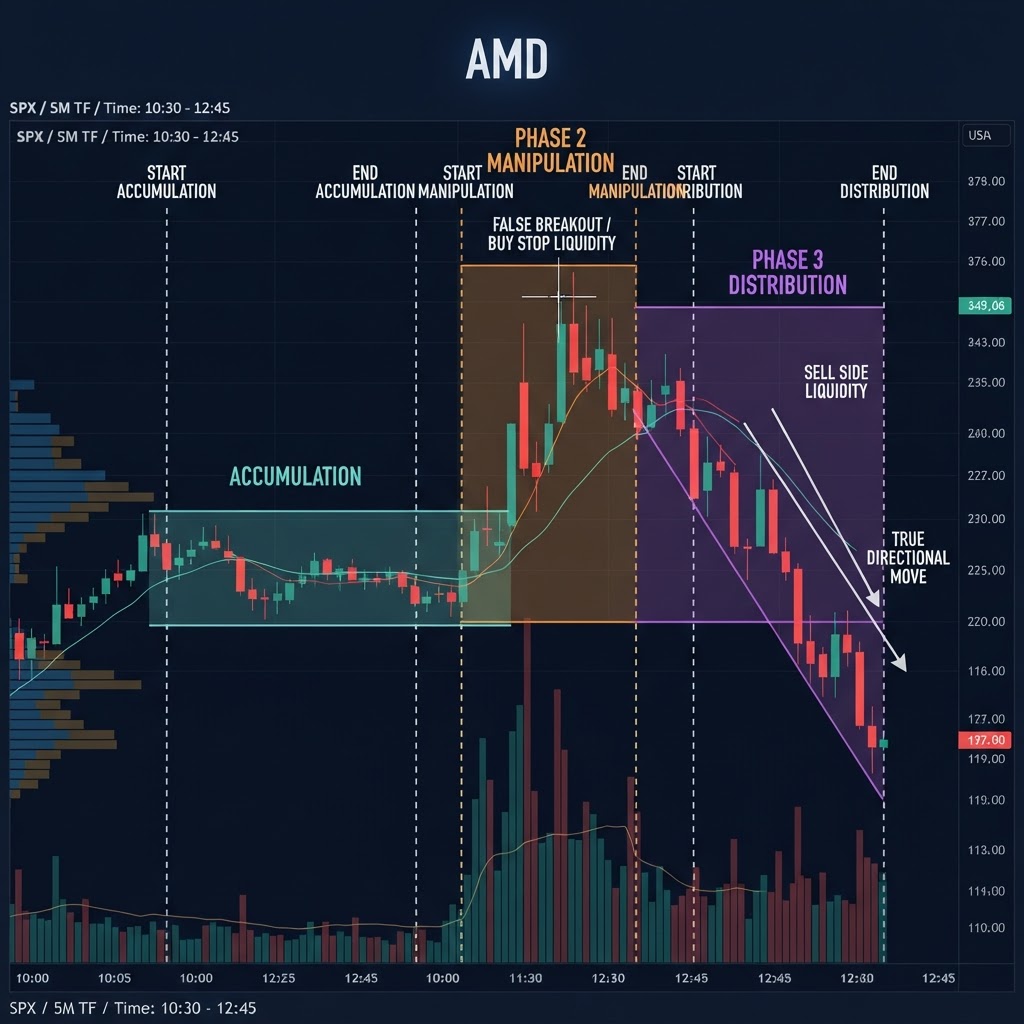
The Power of Three (AMD — Accumulation, Manipulation, Distribution) is the ICT meta-framework that synthesizes the observation, grounded in Wyckoff method theory (Wyckoff 1930s) and modern market-cycle research, that price action across any timeframe (a session, a day, a week) follows a recurring three-phase structural cycle. The cycle is not random: it reflects the institutional process of building a position (Accumulation), generating the liquidity needed to fill it (Manipulation), and then executing the directional move (Distribution). The framework is fractal — it repeats on the 1-minute, the hourly, the daily, and the weekly, which is why the operator who understands AMD can read institutional intent across timeframes.
Technical Definition
The Power of Three describes three sequential phases: (1) Accumulation — a consolidation range where institutional positions are built and retail stop-losses accumulate above and below the range; (2) Manipulation — a false move (typically a Judas Swing or liquidity sweep) that breaks one range extreme to trigger the accumulated stops and fill the institutional contra-side; (3) Distribution — the true directional move in the opposite direction of the manipulation, which represents the institutional position being driven to its target. The cycle repeats fractally on every timeframe.
Order-Flow Microstructure
In Accumulation, the institutional participant builds a position within a range — buying at the lower boundary, selling at the upper boundary — while retail traders range-trade and place stop-losses beyond both extremes. In Manipulation, the institution sweeps one extreme (e.g., the low) to trigger sell stops (which are buy orders) and fill the final portion of its long position at the lowest available price. In Distribution, with the position complete and opposing liquidity consumed, the institution drives price in the true direction (upward) toward its target — the opposing liquidity pool (the range high, equal highs, or a higher-timeframe level). The three phases are the institutional playbook in miniature: build, grab, drive. Understanding which phase is occurring tells the operator whether to wait (Accumulation), prepare (Manipulation), or execute (Distribution).
Identification Framework
1) Accumulation: identify a consolidation range (e.g., the Asian session range, or a multi-day consolidation). Mark the high and low — these are the liquidity targets. 2) Manipulation: at a session open or structural trigger, price breaks one range extreme. Assess whether the break is displacement-grade (genuine) or a wick-and-reject (manipulation). A manipulation break lacks displacement, leaves a long wick, and is followed by a reversal signal (ChoCH on the lower timeframe). 3) Distribution: price reverses through the range and breaks the opposite extreme with displacement (BOS). The true move is in this direction. The operator does not enter during Accumulation (it is preparation) or during Manipulation (it is the trap) — they enter at the transition from Manipulation to Distribution, confirmed by the ChoCH+BOS.
Confluence Architecture
The Power of Three is a meta-framework, not a standalone entry. It confluences with every other ICT concept: the Manipulation phase is a Judas Swing or liquidity sweep; the Distribution phase begins with a ChoCH and BOS; the entry within Distribution is typically at an OB or FVG in the true direction; the timing is governed by Killzones. The full AMD setup is: Asian range (Accumulation) -> London sweep of Asian high/low (Manipulation) -> ChoCH + BOS in the true direction -> entry at a 15m or 5m OB/FVG (Distribution) -> target the opposite Asian extreme and beyond. This is the canonical ICT daily trade, and it is the application of AMD to the session timeframe.
Institutional Execution Model
1) Identify the Accumulation range (e.g., Asian session high and low). 2) Wait for the Manipulation: at the London open, watch for a sweep of one range extreme. 3) Confirm the transition to Distribution: a lower-timeframe ChoCH in the opposite direction of the manipulation, followed by a BOS. 4) Entry: on the BOS retest or at the first OB/FVG in the Distribution direction, with stop beyond the Manipulation extreme. 5) Target: the opposite Accumulation range extreme first, then the next higher-timeframe liquidity pool. The AMD framework also governs exits: in a Distribution phase, scale out at opposing liquidity, not at arbitrary R/R multiples — the target is where liquidity sits, not where the math is round.
Risk Management Framework
AMD-based trades (entering at the Manipulation->Distribution transition) are the highest-probability ICT setups because they align with the full institutional cycle. Risk 1-1.5% per trade. The stop is placed beyond the Manipulation extreme — if price closes beyond it, the manipulation was not a false move but a genuine breakout, and the AMD reading was wrong. Exit immediately. The operator does not hold an AMD trade through a return to the Accumulation range midpoint (Equilibrium) without scaling — if price stalls at Equilibrium, the Distribution phase may be weak. The fractal nature of AMD means the operator can hold a higher-timeframe AMD trade (e.g., weekly Accumulation) through lower-timeframe AMD cycles, scaling at each Distribution target.
The institutional operator deploys Power of Three (AMD) only when the full confluence stack is present — structure, order-flow imbalance, value alignment, and Killzone timing. The edge is not the pattern itself; it is the convergence of independent confirmations that collectively reduce the false-positive rate to acceptable levels. Trade the process, not the outcome.
Power of Three (AMD) — Test your knowledge
Sign in to take the quiz
Quizzes are reserved for registered users. Create a free account to test your knowledge, track your progress and save your results to your personal profile.
Weekly market setups, new guides and AI insights. Free, zero spam.