Judas Swing
Institutional Thesis
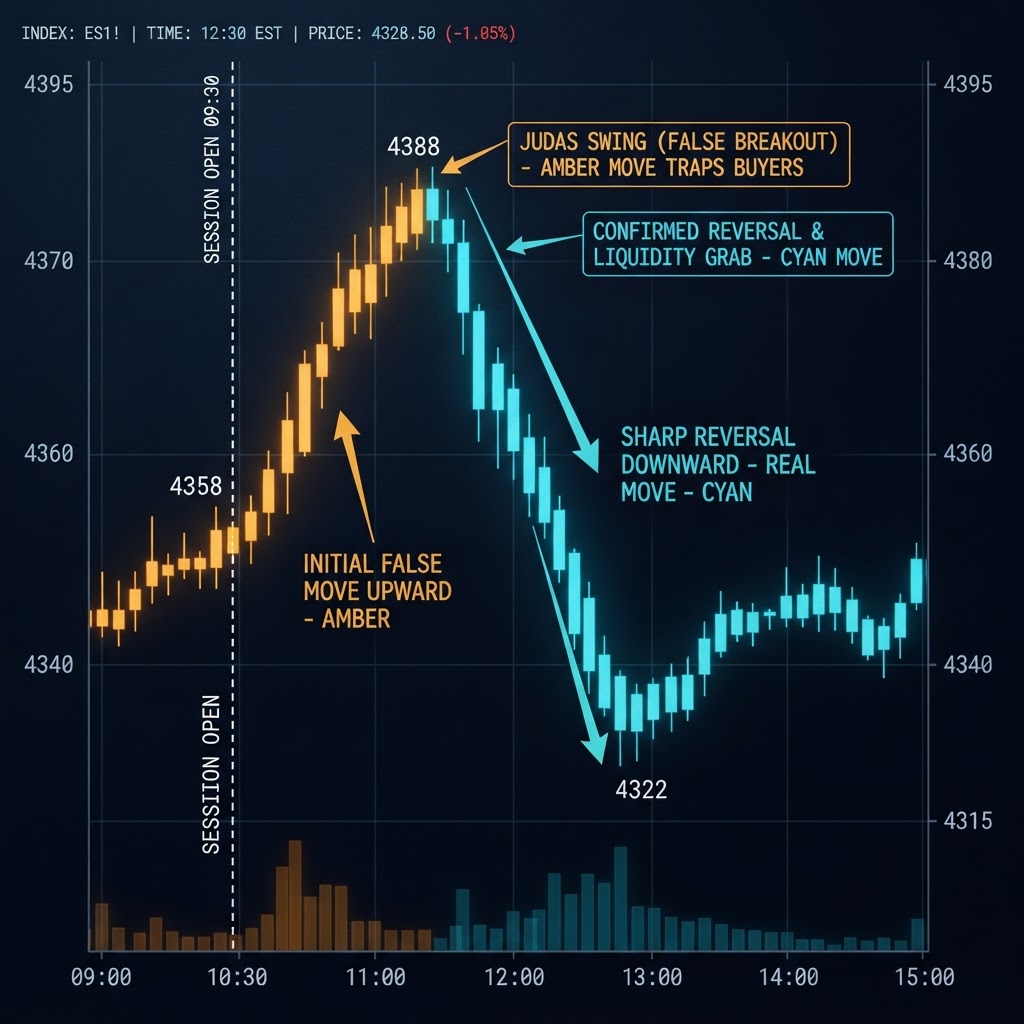
The Judas Swing is the ICT nomenclature for the empirical phenomenon, well-documented in session-opening behavior studies, that the first directional move after a major session open (London or New York) is disproportionately likely to be a false move — a liquidity-generating maneuver in the opposite direction of the session's true intent. The name references betrayal: the move appears to commit to a direction, attracts retail order flow, and then reverses. This is not random — it is the institutional mechanism for generating the contra-side liquidity needed to fill the true directional position. The Judas Swing is the Manipulation phase of the Power of Three cycle.
Technical Definition
The Judas Swing is a false directional move that occurs in the first 30-90 minutes after a major session open (London or New York), which breaks a prior range extreme (typically the Asian high or low for the London Judas, or the London high/low for the NY Judas) to trigger breakout orders and stop-losses, then reverses sharply into the true directional move of the session. It is the institutional liquidity-grab that precedes the real move.
Order-Flow Microstructure
At the London open, institutional desks need to fill large directional positions. To buy, they need sell-side liquidity; to sell, they need buy-side liquidity. The Asian range, built over the prior 4-6 hours, has accumulated stop-loss orders above its high and below its low — breakout traders and range-traders have placed bets on both sides. The Judas Swing sweeps one side: if the true intent is bullish, the institution pushes price below the Asian low (triggering sell stops, which are buy orders that the institution absorbs), then reverses upward into the true bullish move. The sweep below the low is the Judas Swing — it betrays traders who shorted the breakdown. The mechanism is symmetric for bearish intent. The Judas Swing is the visible manifestation of institutional liquidity management at the session open.
Identification Framework
1) Mark the Asian range high and low (for the London Judas) or the London high and low (for the NY Judas). 2) At the session open, observe the first directional move. 3) If price breaks one range extreme in the first 30-90 minutes but the break lacks displacement (no strong close, no FVG, low volume), it is a candidate Judas Swing. 4) Confirm the Judas: price reverses back through the range and breaks the opposite extreme with displacement (ChoCH + BOS). The true move is in the direction of the reversal, not the initial break. The Judas is identified in retrospect by the false break + reversal sequence; the operator does not trade the initial break — they wait for the reversal confirmation.
Confluence Architecture
The Judas Swing is the Manipulation phase of the Power of Three (AMD). It gains reliability when: (1) the swept level was a significant liquidity pool (equal highs/lows, prior session high/low, round number) — a richer pool justifies a more deliberate Judas; (2) the reversal is confirmed by a lower-timeframe ChoCH and BOS — the ChoCH is the first structural signal that the initial break was false; (3) the reversal direction aligns with the higher-timeframe bias (e.g., if the Daily is bullish, a bullish Judas reversal at the London open is higher-probability); (4) the reversal finds confluence at an OB or FVG in the true direction. The Judas + ChoCH + BOS + confluence sequence is the institutional daily setup.
Institutional Execution Model
1) Prepare: before the London open, mark the Asian range, identify higher-timeframe bias, and locate higher-timeframe OB/FVG levels. 2) Observe: at the London open, watch which Asian extreme is tested. Do not enter on the initial break — it may be the Judas. 3) Confirm: wait for price to reject the swept level and form a lower-timeframe ChoCH (e.g., on 5m or 15m). 4) Enter: on the ChoCH (or on the subsequent BOS retest), in the direction of the reversal, with stop beyond the Judas extreme (the swept level). 5) Target: the opposite Asian range extreme (the high if the Judas swept the low) and then the next higher-timeframe liquidity pool. R/R on clean Judas reversals is typically 1:3 to 1:5 because the stop is tight (just beyond the sweep) and the target is the full range plus extension.
Risk Management Framework
Judas Swing reversals are high-conviction setups when the ChoCH confirms the false break. Risk 1-1.5% per trade. The stop must be beyond the Judas extreme — if price returns beyond the swept level and closes there, the initial break was not a Judas but a genuine breakout, and the thesis is dead. Do not widen the stop; the Judas setup's edge is the tight stop relative to the large target. Scale out 50% at the opposite range extreme and trail the remainder using lower-timeframe structure. The institutional operator does not chase a Judas that has already reversed significantly — the entry window is the ChoCH and the first pullback, not the extended move.
The institutional operator deploys Judas Swing only when the full confluence stack is present — structure, order-flow imbalance, value alignment, and Killzone timing. The edge is not the pattern itself; it is the convergence of independent confirmations that collectively reduce the false-positive rate to acceptable levels. Trade the process, not the outcome.
Judas Swing — Test your knowledge
Sign in to take the quiz
Quizzes are reserved for registered users. Create a free account to test your knowledge, track your progress and save your results to your personal profile.
Weekly market setups, new guides and AI insights. Free, zero spam.